Speaking, for me, followed writing, but it grew from the same root: the conviction that criticism is a conversation more than a verdict. Years of blogging taught me to write toward an audience, building it slowly, since one never just exists for your work when you’re trying to do something new. Online writing allowed me to hear back from the audience, which could be thrilling, and the podium turned out to be another version of that exchange — slower than a comment thread, warmer than a byline. It connected me to a Socratic tradition that involved as much listening as lecturing. What follows is a record of where some of those conversations have taken place.
Keynotes and Lectures
The keynotes have often been occasions to argue for what the art world undervalues. At the American Craft Council’s “Present Tense” conference in Philadelphia, my 2019 keynote made the case for why craft matters (later adapted for American Craft magazine). The following year I delivered the keynote for Artshub’s Visions 2020 (video), a rallying cry for the future addressed to Australia’s arts sector as the pandemic reshaped it. In 2022, I joined Kamal Sinclair for the arts and tech keynote session at the Grantmakers in the Arts conference, and in 2023 I keynoted the International Encaustic Conference at Castle Hill on Cape Cod, Massachusetts.

My earliest public lecture was on a favorite topic, the use of humor in art criticism. I spoke in 2013 at the New York Studio School about the long history of humorous art criticism beginning with the grandfather of modern Western art criticism, Diderot, until our own meme-fied era. My journalism has also been foundational to my public presentations, and I spoke at the 2017 Indigenous New York symposium at the Vera List Center for Art and Politics about my experience at Standing Rock, which I visited in 2016 with no expectation of reporting from the gathering but quickly switched into journalist mode after I realized the seismic importance of the event. For the three days I was there, I recorded and listened as much as I could, following the media guidelines the Oceti Sakowin camp organizers drafted for journalists.
The question of what and who criticism is for is something I return to again and again in my talks. At Yale University, as part of the Poynter Fellowship in Journalism, I delivered “You Don’t Hate Me, You Hate Yourself and Other Epiphanies About Art Criticism in the 21st Century” (2024) — the title says a lot, but it was overall a heartfelt conversation about what people today actually want from criticism rather than what they profess to. Print publication writers could afford to ignore the ebbs and flows of their audience’s interests, but online statistics dispel wishful thinking, showing us where eyeballs and ears actually linger. At the Chautauqua Visual Arts Lecture Series, where I was lecturing as a lead mentor in the Visual Arts program, I asked “What the hell do art critics do?” (2019), and only a year before at SUNY Purchase, in a lecture presented by the East++ Institute for New Artistic Inquiry and the Neuberger Museum of Art, I mapped “The New Territories of Contemporary Art” and their disturbances of the status quo.
Queerness is another prominent theme in my work — less a subject I focus on than a framework that informs everything I do. I often foreground queer and trans artists in my conversations and essays, and some have centered it, like this panel at Swann Galleries in 2019 as part of their groundbreaking series of annual LGBTQ+ auctions that highlight important queer art and ephemera for collectors and collecting institutions. I also shepherded the annual Pride month series at Hyperallergic, initiated by Zachary Small during their tenure as staff reporter, and it has since evolved to incorporate queer elders and new themes each year. Hyperallergic remains, to my knowledge, the only major LGBTQ+-owned English-language art publication, and that has shaped its perspective from the first post.
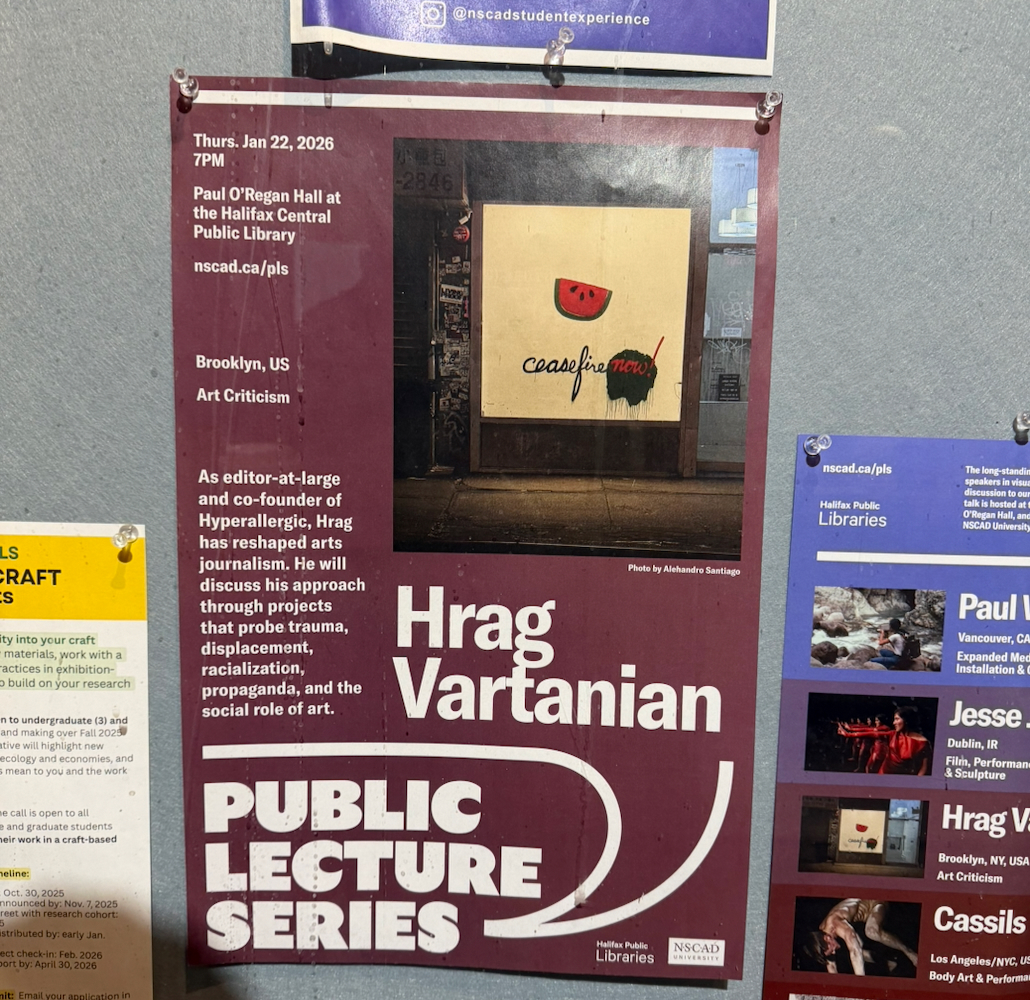
Other talks carry the preoccupations readers will recognize from my writing — heritage, displacement, and what empire shatters and leaves behind. Many of the lectures are first drafts of longer essays and future book chapters, like “Negative Space and Complicity,” which was my contribution to the Templeton Colloquium Cultural Heritage at Stake: Between Conservation and Criminality at UC Davis (2025) in California. I spoke about borders and the role of the critic amidst the machinations of global empires and what is counted as art, and by whom — it was my second time at the school, as I was a visiting artist in 2015–2016, when I spoke about my work as an art journalist in the field. At the Halifax Public Library in Nova Scotia, Canada, I presented “Mapping New Geographies of Belonging and the Lines that Divide from Within” (2026) as part of NSCAD University’s visiting artist program. I asked the people in attendance to imagine a world without borders and spoke about the artists who dream them away.
I’ve been rekindling my love of performance lectures, and in 2024, as part of Artsakh Uprooted: Aftermaths of Displacement at USC Dornsife, I performed “Roots Across Diasporan Time,” with artist and scholar Aroussiak Gabrielian. The symposium convened in the wake of the Artsakh genocide that displaced over 100,000 people the year before.
Conversations and Panels

Some of my favorite events are simply conversations with artists, like my 2014 Crossing Brooklyn series, presented with the Brooklyn Museum as part of its exhibition of the same name, Crossing Brooklyn: Art from Bushwick, Bed-Stuy, and Beyond, a survey featuring 35 Brooklyn-based artists. The three conversations expanded the scope of the show, bringing in more artists — among them Nobutaka Aozaki, Youmna Chlala, Christen Clifford, Linda Goode Bryant, McKendree Key, Andrew Ohanesian, Dread Scott, Caroline Woolard, and Bryan Zanisnik. In 2016, I led a conversation at the Brooklyn Museum with Valerie Hegarty, which was covered by Lizanne Merrill at Artlyst, who wrote, “The conversation went from zero to unbelievably interesting very quickly.” At the 2017 College Art Association (CAA) in New York City I organized a well-attended dialogue with the founders of MTL+ Collective and members of Decolonize This Place, Nitasha Dhillon and Amin Husain, which was a rare opportunity for art historians, artists, and arts leaders to hear directly from two leading artist activists — three years later, I also recorded a two-part podcast with the duo expanding on the same themes. In 2018, my contribution to the McKnight Visual Artist Discussion Series was leading a conversation with artist Erik Benson and Julie Buffalohead at the Minneapolis Institute of Art. The following year I had a public dialogue with Shary Boyle at Toronto’s Gardiner Museum in the city where I grew up, which is always a special treat. And in 2021, I returned to Toronto — this time virtually — to speak to Ai Weiwei for an event hosted by the Art Gallery of Ontario, about his moving memoir 1000 Years of Joys and Sorrows. I also had a conversation with artist Chloë Bass (2025) at the School of Visual Arts, as part of the MFA Art Practice program, where we discussed two decades of her art and how the art community in New York has changed.
I’ve been on countless panels, more than I can ever remember, but one notable appearance was at the Swiss Institute in 2017, in a conversation moderated by writer and curator Nikki Columbus with Bice Curiger, artistic director of the Fondation Vincent van Gogh Arles; art historian and theorist Hal Foster; and Michelle Kuo, then editor-in-chief of Artforum and now chief curator at large and publisher at the Museum of Modern Art. We spoke about the relationship between art publishing and art criticism and I emphasized the need to modernize that relationship, something that drives so much of what I do in publishing.
In the Media
I also appear where art news meets the general public. I am one of the primary subjects of Out of the Picture (2023), Mary Louise Schumacher’s feature-length documentary about art critics living through a period of transformation for both art and media, and I helped to narrate HBO’s Banksy Does New York (2014) (watch online), about the street artist’s unofficial residency in the city — a story I had covered daily as it unfolded, and also spoke about the experience on the November 1, 2013 episode of KCRW’s To the Point.

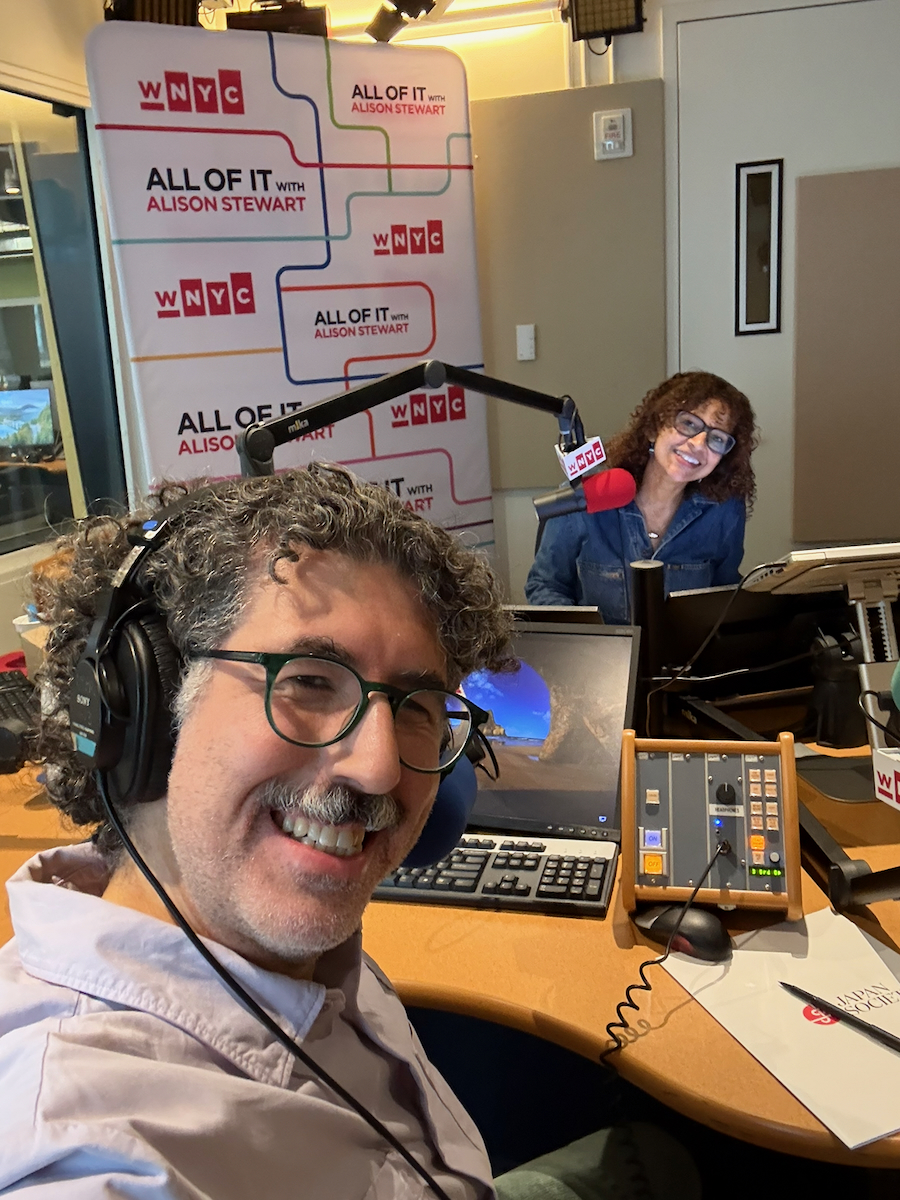
And when art becomes news, broadcasters and reporters have called: Al Jazeera tapped me to talk about the release of Ai Weiwei by Chinese authorities (2011), CBC’s Q to argue against Ai Weiwei’s recreation of the Alan Kurdi photograph (2016) and on the strange case of Peter Doig being taken to court over a painting he says he never made (2016), the Brian Lehrer Show during the 2015 Frieze New York Week, Bloomberg Radio on art investing, WNYC’s All Of It on the protests at the Whitney Museum (2018 and 2019), with Alison Stewart, on ten artworks everyone should see in New York (2024), BBC World News onBBC World News on Jeff Koons’s new public artwork in Paris (2019), and CBC News on Montreal’s immersive van Gogh spectacle (2019). My advocacy for an art strike after the 2016 election became a story itself, taken up by Emily Eakin in the New Yorker (2017) and debated across the art press, and my writing and public presence have rippled outward in other ways — cited in Holland Cotter’s “Lost in the Gallery-Industrial Complex” (2014) in the New York Times, pulled into a spat with Meow Wolf in the Denver press after they responded to a Hyperallergic critic’s “late-stage capitalism” assessment by claiming I held a grudge because of old social posts. Over the years, that visibility has extended well beyond the anglophone press, into Armenian, French, German, Spanish, Swedish, and Turkish media.
In 2017, I spoke to journalist Alicia Eler at the Minneapolis Star-Tribune about Sam Durant’s “Scaffold” controversy, and how his decision to resolve the artwork may be a strong gesture that history will take note of. The same year, Ray Mark Rinaldi spoke to me about my Fixed Point Perspective exhibition at Minerva Projects for the Denver Post.
In 2020, I had a flurry of media mentions as the media ecosystem was supercharged by the new online attention brought on by the pandemic. I spoke to journalist Carolina Miranda at the LA Times (2020) to provide some context for the artistic actions in response to the then ongoing Artsakh Genocide. I was also interviewed by the Hairenik newspaper (2020, in Western Armenian), then the Armenian Mirror-Spectator asked me about Armenian Art through the gaze of Western institutions, while the Washington Post and The Conversation discussed the pandemic-era meme bounty, including the popular ones I created for Hyperallergic. Though I may have been most proud when my quirky story about a gerbil-sized art museum was picked up by Smithsonian Magazine.

Sometimes I’m asked to comment on non-art matters, like when in 2016 Pete Wells spoke to me about Canadian Thanksgiving and how those of us Canadians commemorate a day like that in the US, where Thanksgiving is the following month.
I enjoy being on other people’s podcasts as I find it a warm way to tell stories and share knowledge. My first-ever podcast appearance was on the forerunner in the field, Bad at Sports, an artist-led podcast based in Chicago (Episode 363: Hrag Vartanian & Hyperallergic) that spoke to me at the NADA fair during Miami art week in 2011 (published August 13, 2012). It was probably one of the first introductions many people outside New York had the chance to hear me speak, and I sound so enthusiastic about the future of the site, which was only two years old at the time. As the years went by, I spoke to The Conversation // Art Podcast (2014), Fresh Art International (2016, 2017, and 2019), two appearances on Public Radio Tulsa’s Museum Confidential (2017 and 2019), AC Institute (2018), Two Old Bitches Podcast (2019), East Is a Podcast talking about the art world 1% (2019), the MA in Craft Studies program at Warren Wilson College podcast with their inaugural graduate Darrah Bowden (2020), Truth In This Art (2023), and The Curatorial Blonde (2025).
The invitation that stays with me most, though, was far more personal as BBC World Service asked me to offer a remembrance of my aunt Zabel Hamalian, lost to COVID-19 in Syria, on its OS program in 2020 — a public space to mourn someone I deeply loved, which is its own kind of witness.